
The Time of the Minimalist Kitchen Has Passed: Welcome Vibrant Stone Finishes
For more than a decade, the aspirational kitchen arrived in shades of almost nothing: white cabinetry, pale quartz, a discreet splashback, and minimalist hardware. It was orderly, photogenic, and, at its best, serene. But the immaculate, low-contrast kitchen is beginning to feel less like a design ideal and more like a holding pattern.
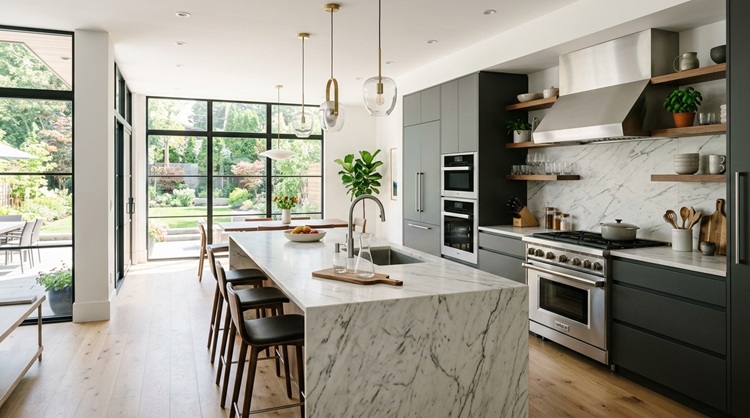
The new mood is much more exuberant. It is about colour with geological depth, pattern with provenance, and stone that is permitted to be the room’s most expressive element. Think oxblood-veined marble, olive quartzite, or a honeyed travertine. This is not maximalism for its own sake. It is a more cultivated form of warmth: material-led, tactile, and gloriously individual.
The kitchen is no longer treated as a sealed-off utility room or a backdrop for entertaining. It is the most public room in many homes, a place where breakfast, homework, late-night drinks and impromptu dinner parties overlap. A surface with variation provides all that activity with a setting that feels lived-in.
Stone is uniquely suited to the task. Its movement is never entirely repeatable; its colour changes through the day; its patina becomes part of the story. In other words, it offers something the all-white kitchen often could not: atmosphere.
Let the Stone Do the Talking
Don’t try to throw a pattern at every surface. Choose one exceptional slab and allow it enough visual space to hold the room. A dramatic Calacatta Viola with wine-dark veining can make simple walnut cabinetry feel worth a movie shot. Deep-green quartzite against brushed brass looks polished rather than precious. Soapstone, with its inky softness, offers an appealing counterpoint to warm plaster and creamy oak.
There is sound commercial logic behind this renewed appetite for veining, too. In Houzz’s 2025 U.S. Kitchen Trends Study, 74% of homeowners upgrading countertops chose a veined pattern; speckled and uniform finishes each accounted for just 13%. The lesson is not that every kitchen needs a spectacular, book-matched range wall. It is that visual uniformity is no longer the default shorthand for luxury. The most expensive-looking rooms now have a point of view.
Backsplashes Become Architecture
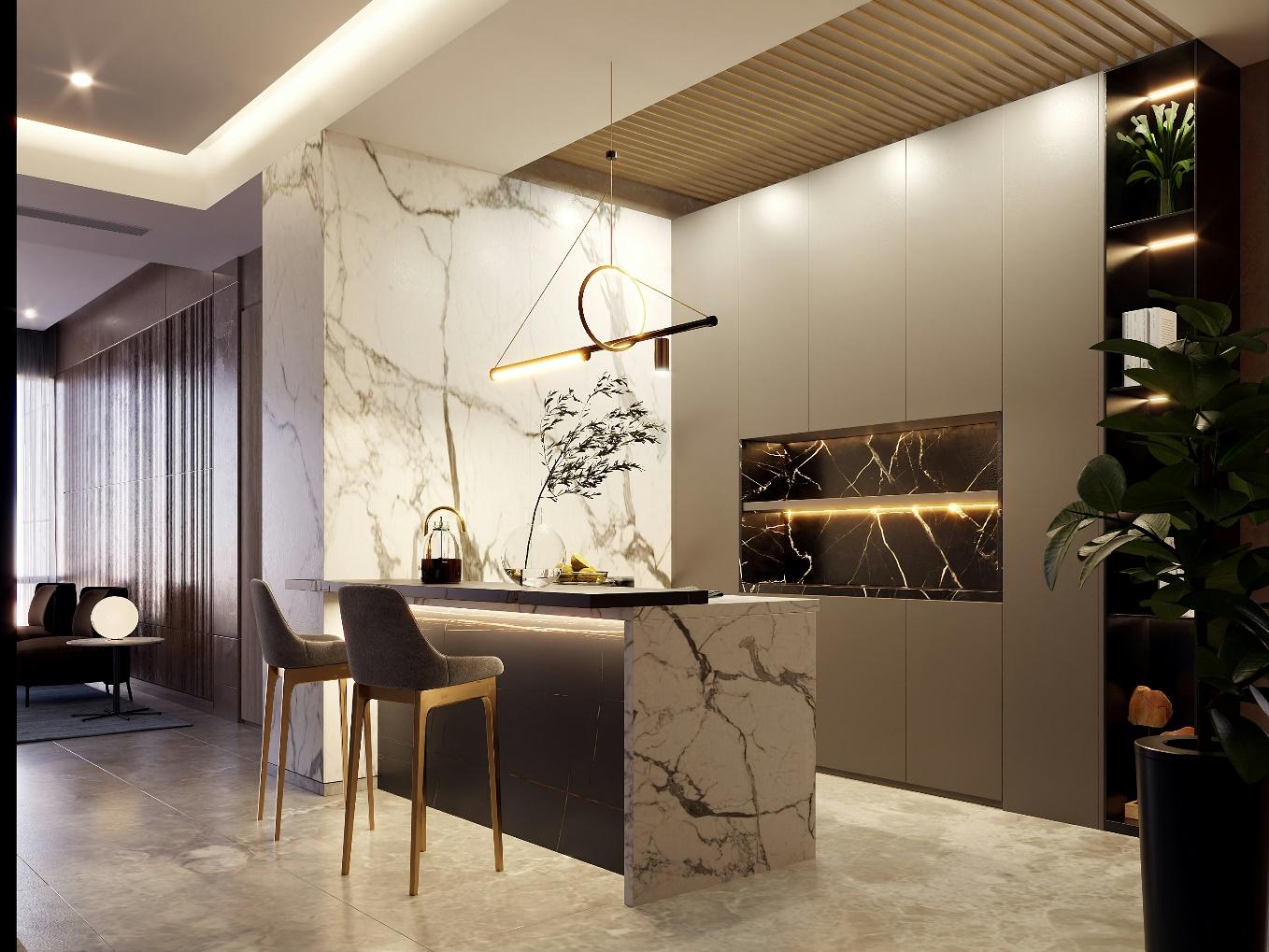
Perhaps nowhere is the change more visible than behind the cooker. The old formula (white rectangular tile, neat grout lines, minimal interruption) is giving way to surfaces with scale and ambition. A full-height stone splashback can turn an ordinary wall into an architectural plane; a mosaic backsplash in rich marble tones can introduce craft without making the room feel busy.
The most convincing applications carry a stone’s colour story across the room. A rust thread in the backsplash might reappear in the leather of the counter stools; a soft sage vein may be echoed in the painted pantry door.
The Case for Imperfection
Minimalism’s great promise was ease: fewer decisions, fewer visual interruptions, fewer things to tire of. But stone offers a different kind of longevity. It does not remain pristine but gains character with time.
Marble and travertine may show signs of use or slight color changes with time – however, these won’t look like flaws; instead, they will be perceived as character. Quartzite and many granites tend to be more forgiving for hard-working counters. The most successful specification is not the most precious stone, but the one whose ageing process suits the household.
This is also why smaller-scale applications are proving so compelling. Marble mosaics in a pantry, a coffee nook or the interior of a glazed cabinet bring depth and decorative intelligence without asking a family kitchen to behave like a museum. A stone-lined niche, meanwhile, can create a moment of delight with a comparatively modest amount of material.
How to Make the Look Feel Enduring
Vibrant stone is at its most sophisticated when it is balanced by limited palette elsewhere. Pair an assertive slab with cabinetry in a quiet, grounded finish: tobacco oak, warm mushroom lacquer, putty-toned paint or darkened ash. Let the hardware be secondary. Avoid competing decorative gestures, particularly busy pendant lights or multiple clashing patterns.
Lighting deserves the same consideration. Stone changes character under warm, layered illumination, so use concealed under-cabinet lighting to reveal depth in the veining and softer ambient lighting for evening.