
For the most progressive digital business landscape, one term you’ve probably heard before is SaaS (Software as a Service) – the kind of software that you log in to, and make use of, for instance email or project administration software or CRMs. However, as a business or blog grows, you might find another acronym: CaaS, or Containers as a Service.
If it seems like another technical obstacle, then it’s a big one for all those trying to expand their online presence or run complex applications without the large-scale infrastructure of a traditional IT environment.
What is CaaS?
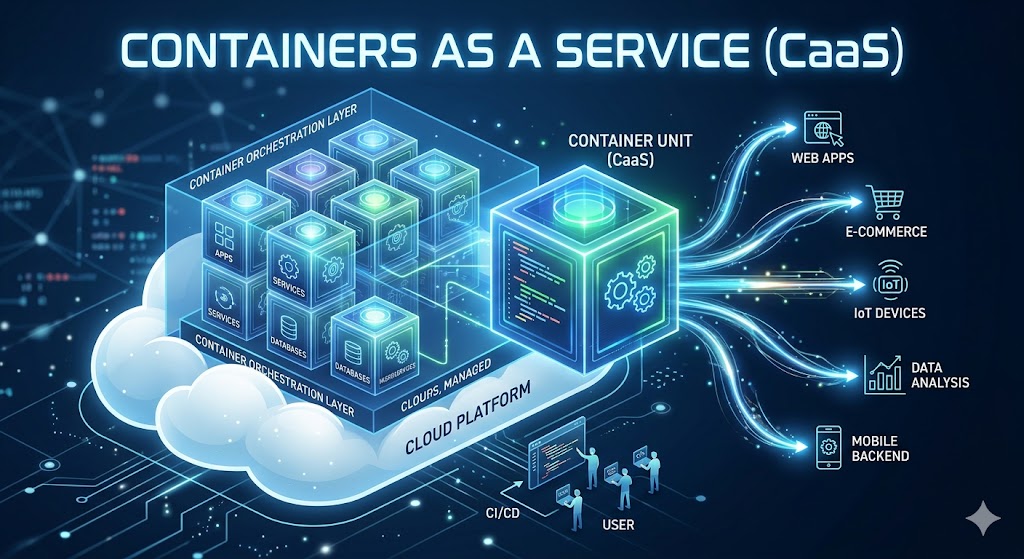
The container is simply an “virtual office space” that is mobile, for your software programs. It bundles up an application and all of its requirements so that it runs seamlessly regardless of whether it’s running on your laptop or on a cloud server.
The platform that takes care of these containers is known as Containers as a Service (CaaS). It lies in between Infrastructure as a Service (IaaS) and Platform as a Service (PaaS).
IaaS provides complete control and leaves users to handle nearly all the work.
In PaaS, a lot of the infrastructure is being abstracted and the focus is on development.
CaaS fills the gap, enabling you to provision and operate your containerized application with the provider taking care of the server and orchestration.
Why Small Businesses Should Care
So what does orchestrating containers have to do with you, the blogger, or the small marketing agency? The solution is SCALABILITY and COST CONTROL.
If you have a seasonal business or a very popular blog, you will need your infrastructure to scale up when the business is booming, and back down when it’s slow. CaaS platforms adapt the required resources dynamically and as per the demand, eliminating the wastage of paying for idle resources.
In CaaS, the cloud provider does the “heavy lifting” of maintaining servers, security updates and infrastructure healing. This allows you to concentrate on what really matters—your content and business strategy, not on dealing with the server problems you’re facing.
Consistent Performance: Code packaged by containers comes with all its dependencies. Your website or app will be responsive, which will give your users a better experience.
Which one do you need – CaaS or SaaS?
It is imperative that the two should not be confused. The selection of the right model is dependent on your business goals:
| Cost per use | Low | Low | High |
|---|---|---|---|
| Selects a ready-to-use application (such as email or CRM) and implements it, or builds a custom app or microservice | |||
| Provider provides control/owns everything | Provider provides balance of control/responsibility | ||
| Some customization | Very high level of customization | ||
| Time to set up | Instant deployment | Needs some technical setup |
When you need to do something daily, and you are not looking for anything that requires maintenance, pick SaaS.
If you are creating custom digital products, moving legacy applications to the cloud, or you are looking for a platform that can scale and evolve according to your digital growth, then your best bet would be to choose CaaS.
The Bottom Line
Growth doesn’t have to be limited by modern cloud infrastructure. Knowing the terms and concepts such as CaaS can help you make better decisions regarding the construction of your digital platforms. From shifting to a microservices architecture to simply optimizing your Web infrastructure, CaaS gives you the agility to catch up with and beat the competition.