
Behind the engine of any rapidly expanding digital company nowadays, you’ll not only discover good coding or great marketing, you’ll also discover great code and great marketing. A web of seamless integrations will be present. We are an API-first economy, and this is a fundamental change in software development that is transforming how online platforms scale.
Although “API” is one of the most common tech acronyms used, the business strategy behind the concept is not always understood. API-first is not only for developers, it’s for anyone who relies on content, whether they are a digital marketer, content creator, website administrator or anyone else.
What is an API in Simple Terms?
Before getting deep into the business strategy, it is crucial to have a clear definition. API is an acronym for Application Programming Interface.
Imagine an API is like a digital translator, or a bridge. For a restaurant site, the front end is the dining room, and the back end is the kitchen. The waiter is the API. Requires user input and returns the same data or service that the user requested.
Each time you see a Google Map on a local business page, each time you utilize a “Sign in with Google” button, each time you sign up for a Stripe payment, an API is working in the background.
Moving from Legacy to “API-First”
A “code-first” or “UI-first” approach to building software was adopted traditionally. The developers would create a whole application, then design the user interface (UI) and add an API only as an afterthought, so that other systems could talk to it. This frequently led to cumbersome and brittle integrations that failed upon software updates.
An API-first approach is the opposite of this.
API-first means taking the API as the main product. They write connectivity, data channels, communication rules before developing any user-facing screens or applications. The software has been designed from the outset to be modular, open and connected up with the rest of the digital world.
Why the API-First Approach Drives Business Growth
For digital brands, leveraging platforms that are API-first have clear competitive benefits:
1. Infinite Scalability and Flexibility.
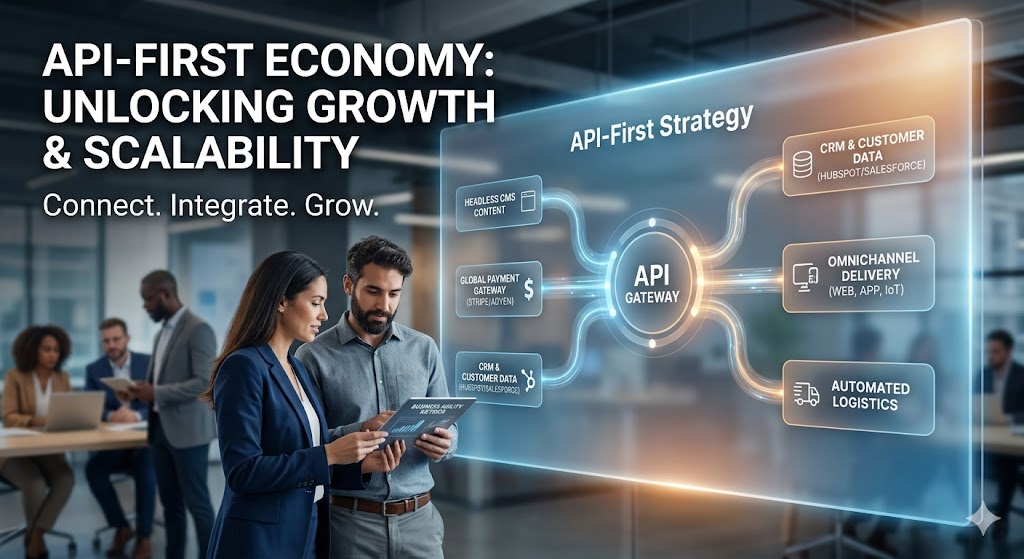
Modular core digital infrastructure means that you are never constrained to a single ecosystem. For example, if you have a website or ecommerce site that is content-focused, you can use a headless CMS (API-first content management system) and have your content separate from your design.
Whether you’re looking to overhaul your website’s navigation into a pill-shaped design, or simply switch your brand’s colour scheme completely, you can do it without having to destroy your base database. The API just sends existing data to the totally new format.
2. Faster Time-to-Market
It is not necessary to re-invent the wheel when introducing a new feature. Within the API first economy, you can combine and configure complex functionality on the business, such as building blocks:
Are you in need of secure payment methods? Connect Stripe.
Need advanced customer data tracking? Connect HubSpot.
Looking for automated transactional emails? Connect Twilio SendGrid.
Small teams can deploy enterprise-level platforms in a fraction of time it would take to build these features from scratch by integrating with world class APIs.
3. Cross-Platform Omnichannel Experience
An API-first application doesn’t have a specific web layout, so your data can take wing. The same API used to give the text meanings and definitions on the desktop site can be used to supply data to a mobile application, mobile watch interface or a customized internal dashboard for your team. Your data stays connected, and your delivery points grow as you go.
The Bottom Line
The API first economy has made everything equal. It enables small digital marketing agencies, bloggers, or individual website owners to benefit from the same high-level infrastructure that is used by tech giants.
The trick to selecting the next tool in your software stack, whether it’s a new plugin, analytics tracker, or content management system, is to go beyond the dashboard interface. You should ask yourself the following question: How easily does it communicate with the rest of my business through its API? Tomorrow’s speed of scaling will depend on the answer to that question.